Buying a Superyacht: What Most Brokers Don't Tell You Before You Sign
The purchase price is the smallest number in a superyacht transaction. Here's what the full cost of ownership looks like, and what to check before you commit.
The purchase price is the smallest number in a superyacht transaction. That's not a warning. it's a fact that changes how you should approach the buying process. If you're evaluating a yacht based on its asking price alone, you're missing most of the picture. This guide covers what the process actually looks like from the inside: the survey, the off-market opportunity, the running costs, the price reduction intelligence, and the questions that most buyers don't think to ask until after they've signed.
The Running Cost Rule
The standard industry estimate for annual running costs is 10% of the vessel's value. On a €5 million yacht, that's €500,000 per year. On a €20 million yacht, it's €2 million. These figures cover crew salaries, insurance, maintenance, fuel, marina fees, and refit costs amortised over time.
The 10% rule is a starting point, not a ceiling. An older yacht with deferred maintenance will cost more. A yacht that's actively chartered will generate income that offsets some of the running costs, but it will also accumulate wear faster. A yacht that sits in a marina unused will still cost money. crew, insurance, and berth fees don't stop when the owner isn't aboard.
Here's a more detailed breakdown for a €10 million, 35-metre motor yacht:
Crew: A captain, chef, first mate, and two deckhands. Total annual salary cost including social contributions: €350,000–€450,000. Insurance: €80,000–€120,000 per year for a vessel of this value. Maintenance and repairs: €100,000–€200,000 per year, depending on the vessel's age and condition. Fuel: €50,000–€100,000 per year for a vessel that's used 8–12 weeks annually. Marina fees: €30,000–€80,000 per year depending on the home port. Refit (amortised): A full refit every 5–7 years costs €500,000–€1,500,000. Amortised annually, that's €70,000–€300,000 per year.
Total annual running cost: €680,000–€1,250,000. That's 6.8–12.5% of the purchase price. The 10% rule is accurate.
The Survey
A pre-purchase survey is not optional. It is the single most important step in the buying process, and the quality of the surveyor matters as much as the fact that one was conducted.
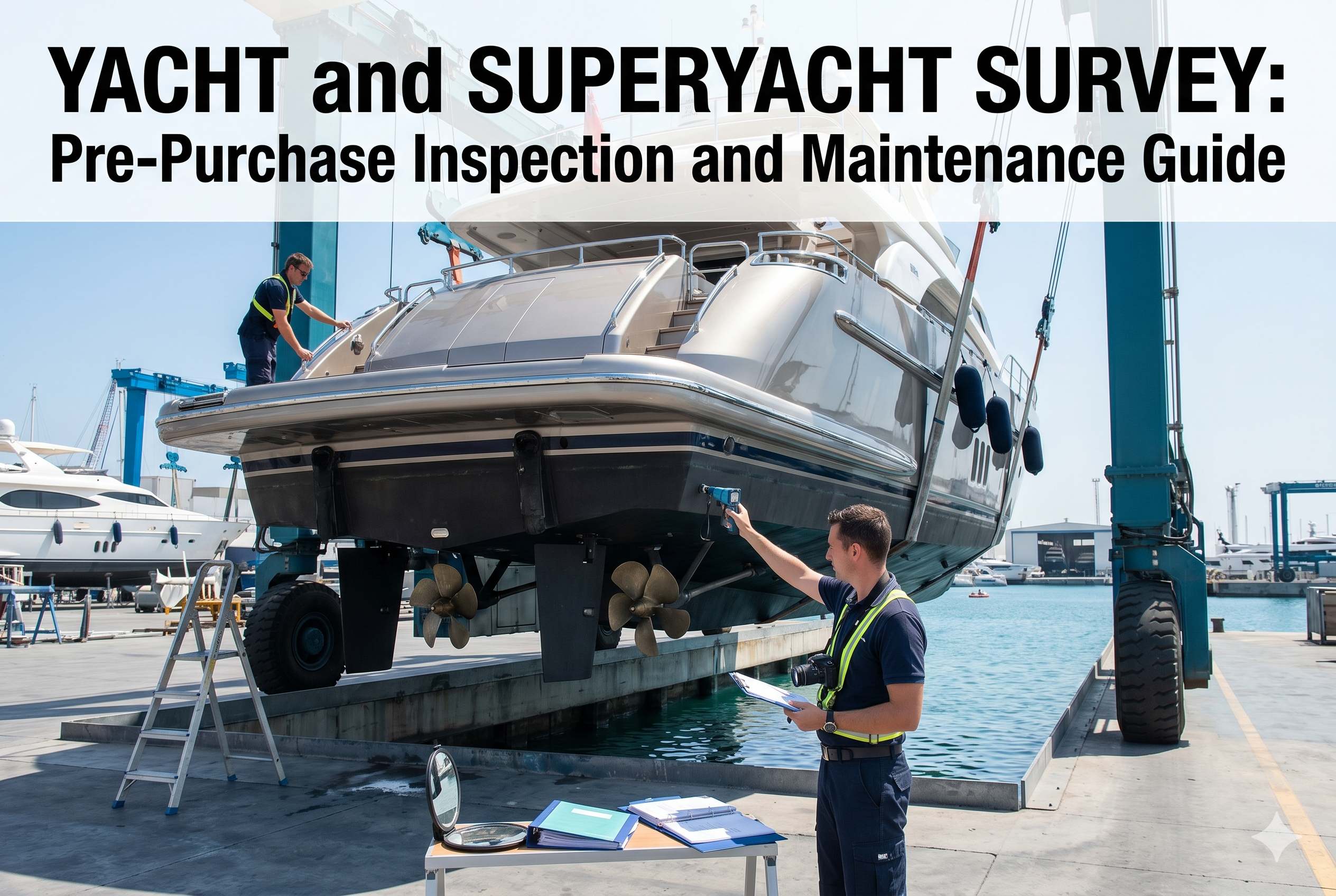
A competent marine surveyor will inspect the hull (including a haul-out to examine the underwater sections), the machinery, the electrical systems, the safety equipment, the structural integrity of the vessel, and the condition of the interior. They will produce a report that identifies defects, estimates the cost of remediation, and gives you a basis for renegotiating the purchase price or walking away.
The survey typically costs 0.1–0.2% of the vessel's value. On a €5 million yacht, that's €5,000–€10,000. On a €20 million yacht, it's €20,000–€40,000. It is the best money you will spend in the entire transaction.
What the survey won't tell you: whether the yacht is a good fit for how you intend to use it. That's a different question, and it's one your broker should be helping you answer before the survey stage. A vessel that surveys perfectly may still be the wrong choice if it's designed for coastal cruising and you want to cross oceans.
The sea trial is separate from the survey but equally important. The sea trial is your opportunity to assess the vessel's performance, handling, and onboard systems under real conditions. It should be conducted in conditions that are representative of how you intend to use the yacht. not in flat calm water on a windless day.
Off-Market Opportunities
The term "off-market" is used loosely in the brokerage industry. It can mean a yacht that is genuinely not listed anywhere, available only through a broker's direct relationship with the owner. It can also mean a yacht that was listed, didn't sell, and is now being offered quietly to avoid the stigma of a stale listing. The distinction matters.
A genuinely off-market opportunity can offer real value. The seller hasn't been through a public marketing process, hasn't received multiple offers, and may be more flexible on price and terms. They may be selling for personal reasons. a change in circumstances, a health issue, a divorce. that create genuine motivation to close quickly. In these situations, a buyer who moves decisively can acquire a vessel at a meaningful discount to its market value.
A de-listed yacht that's been on the market for two years at a price no one would pay is a different situation entirely. The seller has already demonstrated that they're not motivated by price. The fact that the listing has been removed doesn't change the underlying economics.
Ask your broker directly: has this yacht been publicly listed? When? At what price? Why is it off-market now? The answers will tell you what you're actually dealing with.
Price Reductions and Market Intelligence
The brokerage market moves slowly. A yacht listed at €8 million in January may be available at €6.5 million by September if the seller hasn't found a buyer. Price reductions are common, and the pattern of reductions tells you something about the seller's motivation.
A seller who has reduced the asking price twice in six months is more likely to accept a below-asking offer than one who has held the price firm. A yacht that has been on the market for more than eighteen months at the same price is either correctly priced for a patient seller, or overpriced for the market. Your broker should be able to tell you which.
We track price movements across the market and share that intelligence with clients before they make an offer. The difference between buying at the right moment and buying at the wrong one can be 10–15% of the purchase price. On a €10 million yacht, that's €1–1.5 million.
The Transaction
A superyacht purchase involves a Memorandum of Agreement (MoA), a deposit (typically 10% of the purchase price held in escrow), a survey and sea trial period, and a closing process that includes flag registration, title transfer, and VAT settlement.
The legal and administrative costs of the transaction. lawyers, flag registration, VAT, and broker commission. typically add 8–12% to the purchase price. Budget for this from the start. On a €10 million purchase, the total transaction costs are €800,000–€1,200,000.
The timeline from offer to delivery is typically 4–8 weeks for a straightforward transaction. It can extend significantly if the survey reveals defects that require negotiation, or if the flag registration process is complex. Some flag states. notably the Cayman Islands and the Marshall Islands. have efficient registration processes. Others do not.
The Question That Changes Everything
Before you start looking at specific yachts, answer this question honestly: how many weeks per year will you actually use it? If the answer is less than four, the economics of ownership versus charter are worth examining carefully. If the answer is eight or more, ownership starts to make sense. If the answer is twelve or more, ownership is almost certainly the right decision.
The yacht that makes sense for someone who uses it twelve weeks a year is a different yacht from the one that makes sense for someone who uses it four weeks a year. The size, the flag, the crew structure, and the charter potential all change depending on that number.
View our current yachts for sale or speak to Lewis about what's available in the off-market and what the current pricing intelligence looks like for the size and type of vessel you're considering.
Planning a charter?
Tell us your dates and destination. Our charter team will review your brief and prepare a suitable shortlist.