Yacht Charter vs Luxury Villa: Cost, Privacy and Flexibility Compared
A balanced comparison of yacht charter and villa rental, covering total cost, service, privacy, mobility, dining and suitability for families.
Choosing between a crewed yacht charter and a high-end villa changes the structure of the holiday. Both can provide privacy, service, and shared space for families or groups of friends. The main distinction is mobility. A villa is a fixed base with direct land access, while a yacht can move between cruising areas under an agreed operating programme. This guide compares the complete cost structure, privacy, flexibility, accessibility, and daily routine of each option.
Pricing Structure Explained
Understanding the financial framework of both options is essential for making an informed choice. The approach to pricing differs significantly between land-based rentals and sea-based charters.
Luxury Villa Pricing
Villa rentals generally operate on a straightforward pricing model. Guests pay a fixed nightly or weekly rate that covers the exclusive use of the property. This base rate typically includes the property itself, basic utilities, and sometimes a foundational level of staffing, such as housekeeping or a property manager.
However, it is important to account for additional expenses that are not always included in the base rate. Food and beverage costs, private chefs, specialist staff, excursions, and transportation may be billed separately. The advantage of the villa model is that the base accommodation cost is usually easier to identify. A fair comparison requires two itemised quotations built around the same dates, group size, service level, and activities.
Yacht Charter Pricing and the APA
Yacht charter pricing usually separates the base charter fee from the Advance Provisioning Allowance, commonly referred to as the APA.
The base charter fee covers the hire of the yacht and crew under the charter agreement. To cover variable expenses, clients pay the APA, commonly planned at approximately 30 to 40 percent of the base charter fee, subject to the yacht and itinerary [1]. The APA acts as a dedicated fund managed by the captain to pay for fuel, food, beverages, port fees, and other guest-specific expenses.
The preference information supplied before the charter helps the crew plan provisions and guest arrangements. The captain maintains an account of APA expenditure under the charter agreement. Unused funds are returned, while additional funds may be requested if spending exceeds the allowance. This structure supports guest-specific planning but requires a larger advance payment than many villa rentals.
Staffing and Dedicated Service
The level and structure of service differ materially between villas and yachts.
In a luxury villa, the staffing structure is often flexible. Some properties come fully staffed with a chef, butler, and daily housekeeping, while others provide minimal staff, allowing guests to hire private professionals as needed. Villa staff often work set hours and may commute to the property daily. This can appeal to guests who prefer periods of complete solitude without staff present on the premises.
On a crewed yacht, the professional team lives on board and manages navigation, engineering, housekeeping, food service, and guest activities. Service is organised around the charter programme while respecting safety responsibilities and statutory rest requirements. The exact crew size and service style vary by yacht, so clients should ask how the team is structured before booking.
Privacy and Seclusion
Privacy is an important consideration for many groups, but the two options provide it in different ways.
A luxury villa may provide a private estate within enclosed grounds, a gated community, or a remote setting. Actual privacy depends on the property boundaries, neighbouring buildings, staff access, security arrangements, and local surroundings.
A yacht can use distance from shore as a practical privacy advantage and may anchor in bays that are difficult to reach by land. Privacy is lower in busy marinas, and anchoring options depend on weather, local rules, protected areas, draft, and the captain's assessment. A yacht offers mobility, but it does not provide unlimited control over every location.
Mobility and Itinerary Flexibility
The most significant difference between a villa and a yacht is mobility.
A villa serves as a stationary anchor. Guests unpack once and establish a comfortable routine. Exploring the surrounding region requires organizing ground transportation, which can involve navigating traffic or coordinating multiple vehicles for a large group. This fixed base is ideal for those who wish to deeply immerse themselves in a single locale, becoming familiar with local markets, restaurants, and the immediate community.
A yacht charter is inherently mobile. The itinerary can often be adjusted in response to guest preferences and changing conditions [2], provided the revised plan remains safe, legal, operationally practical, and consistent with the charter agreement. Guests can visit multiple islands without repeatedly packing and changing accommodation, but weather and port availability can still alter the plan. For more details on planning a journey, explore options to charter a yacht.
Considerations for Children and Large Groups
When traveling with children or organizing a trip for a large group, space and safety are critical factors.
Villas can suit large, multi-generational families because they may offer several living areas, gardens, playrooms, or a cinema. The extra land-based space can help different generations maintain separate routines. For families with toddlers, the absence of marine transfers may also simplify daily movement, although pool, balcony, and property safety still require attention.
Yachts can suit families, but they require a different approach. Space on board is finite, cabins may be more compact than villa bedrooms, and the layout can require navigating stairs and decks. The crew manages onboard safety procedures and can organise age-appropriate activities within the yacht's equipment, operating limits, and the captain's rules. When accommodating very large groups, many commercial charter yachts are limited to 12 guests unless the vessel is certified for more.
Accessibility and Land Access
The ease of accessing local attractions is a practical consideration that varies between the two options.
Villas provide direct access to land. Depending on location, guests may be able to walk to local facilities or receive visitors without a tender transfer. This can be more practical for spontaneous land-based activities or for guests whose mobility makes embarking and disembarking difficult.
Yacht access to land depends on the location. When docked in a marina, guests can walk ashore. When anchored, reaching land requires a tender transfer and a degree of physical mobility. A tender may provide access to beaches or coves that are difficult to reach by road, subject to landing rules, sea state, and local conditions.
Weather Predictability and Adaptability
Weather affects both formats, but the available responses differ.
In a villa, guests are subject to the local weather patterns. If it rains for several days, the group must find indoor activities within the property or the immediate town. The fixed location means there is no escaping a localized weather system.
A captain monitors forecasts and may adjust the route toward a safer or more comfortable anchorage. That flexibility is valuable, but a yacht cannot guarantee sunshine or avoid every wider weather system. Safety, sea state, distance, port availability, and local restrictions take priority over the original itinerary.
Dining Experiences
Both formats can include private dining, but the staffing, provisioning, and access to restaurants differ.
Many luxury villas allow guests to hire a private chef and arrange menus around the group. Guests may also have easier access to local restaurants. Kitchen and entertaining facilities vary by property and should be confirmed before booking.
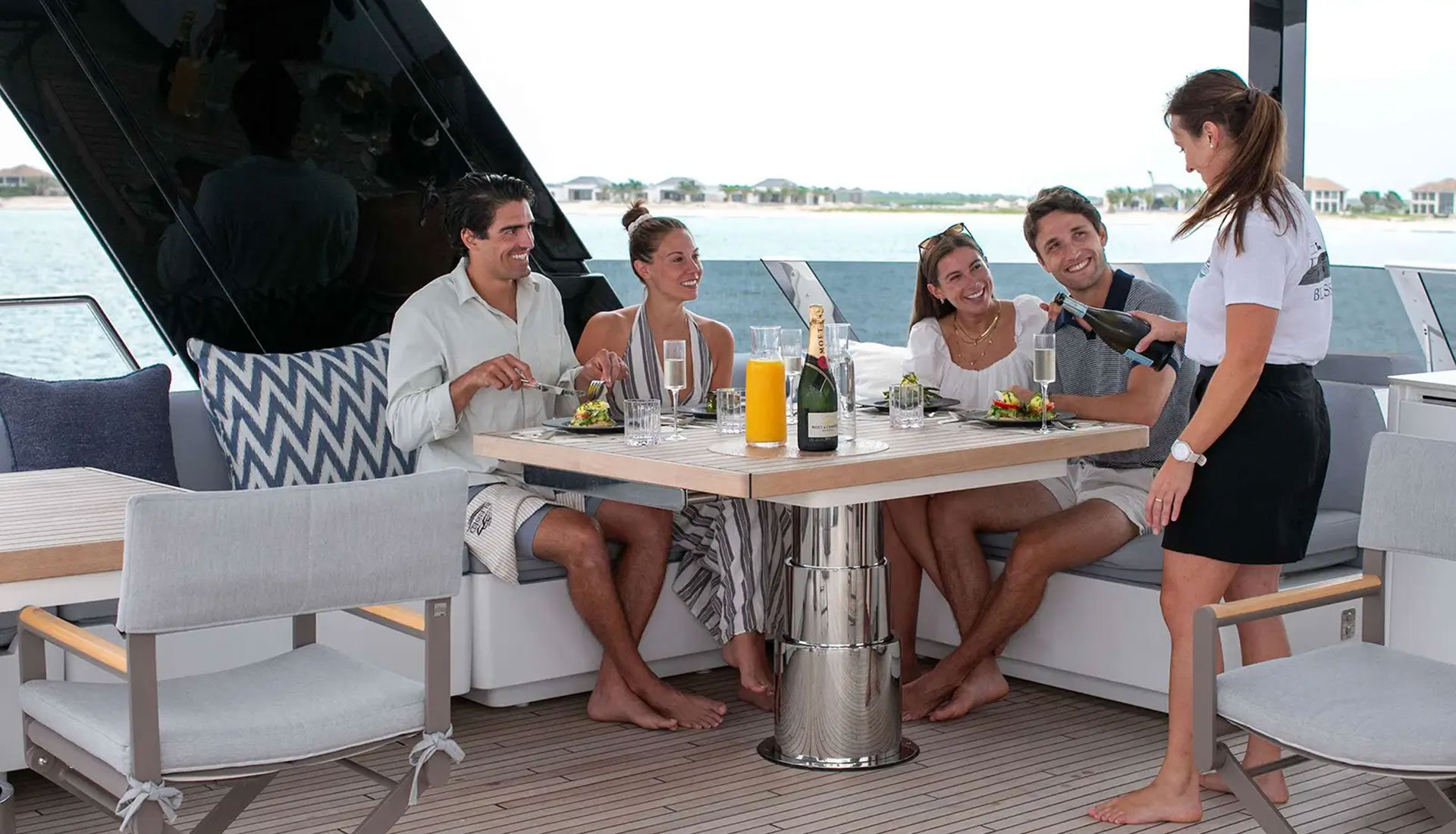
On a yacht with an onboard chef, menus can be shaped around the preference information supplied before the trip, including dietary requirements and the style of dining the group prefers. Ingredient availability varies by cruising area and provisioning schedule. Dining locations may range from an indoor saloon to an aft deck or sun deck, depending on the yacht and conditions.
Activities and Entertainment
The type of entertainment available is closely tied to the environment.
Villas often feature extensive land-based amenities. These can include tennis courts, large swimming pools, fully equipped gymnasiums, spa rooms, and expansive home theaters. They provide a stable environment for wellness retreats or hosting large gatherings.
Yachts are well suited to water-based activities. Many charter yachts carry water toys, but the inventory varies and some equipment requires licences, local permissions, suitable conditions, or additional rental. The crew may also help organise shore activities through local providers. Gyms, cinemas, spas, and other amenities depend on the individual yacht.
Summary Comparison Table
To assist in your decision-making process, the following table highlights the key differences between a yacht charter and a luxury villa.
| Feature | Luxury Villa | Yacht Charter |
|---|---|---|
| Pricing Structure | Fixed base rate, plus separate variable costs | Base charter fee, plus APA for all variable expenses |
| Mobility | Fixed location | Highly mobile, multi-destination itineraries |
| Privacy | Depends on property boundaries, neighbours, and staff access | Can be high away from shore, but lower in marinas and popular anchorages |
| Staffing | Varies from light housekeeping to a resident team | Live-aboard professional crew, with service organised around operations and rest rules |
| Guest Capacity | Can accommodate very large groups | Many commercial yachts carry up to 12 charter guests unless certified for more |
| Land Access | Direct | Requires a tender when at anchor |
| Weather Adaptability | Subject to local conditions | Route may be adjusted when safe and operationally practical |
| Best For | Deep local immersion, large families, stability | Exploring multiple areas, water sports, tailored service |
Who Should Choose Which Option?
The choice ultimately depends on the specific goals of your holiday and the preferences of your group.
A luxury villa may suit you if you:
- Prefer a stable, expansive environment with plenty of ground to explore.
- Are traveling with a very large group or multi-generational family that exceeds standard yacht capacities.
- Wish to deeply immerse yourself in a single local culture, frequenting nearby restaurants and markets.
- Have guests who suffer from severe seasickness or have mobility issues that make tender transfers difficult.
- Prefer a straightforward pricing model where you manage variable costs directly.
A yacht charter may suit you if you:
- Desire the excitement of waking up in a new destination regularly without the need to pack.
- Value a resident professional crew, with service organised around operations and statutory rest.
- Prefer the option to anchor away from shore when conditions and local rules permit.
- Are passionate about the ocean, water sports, and exploring remote coastlines.
- Prefer an itinerary and onboard programme planned around the group's stated requirements.
The better option depends on the complete quotation, group needs, mobility, preferred activities, and tolerance for weather-dependent planning. If ownership is also under consideration, review the current opportunities to buy a yacht. For help comparing charter requirements, use the MY OCEAN contact page.
Frequently Asked Questions (FAQ)
Is a yacht charter more expensive than a luxury villa? The answer depends on the yacht, villa, destination, dates, staffing, transport, food, and activities. Compare complete written estimates rather than advertised base rates. Yacht quotations should show the charter fee, APA, taxes, delivery fees where relevant, and gratuity guidance. Villa quotations should show staffing, food, transfers, local taxes, security deposits, and activity costs.
What happens to the unspent APA at the end of a yacht charter? The captain maintains a detailed ledger of all expenses. Any funds remaining in the APA at the conclusion of the charter are refunded directly to the client in full.
Can we change our itinerary during a yacht charter? Yes. One of the greatest advantages of a yacht charter is flexibility. The captain will work with you daily to adjust the route based on your preferences, weather conditions, and local events.
Are villas better for families with small children? Villas generally offer more land-based space and can be easier for some families with toddlers. Many yachts welcome families, but suitability varies by layout and equipment. Discuss ages, swimming ability, stair access, railings, cabin arrangements, and any safety-netting request before confirming the yacht.
Conclusion and Next Steps
Deciding between a yacht charter and a luxury villa involves weighing the desire for stability and space against the appeal of mobility and dedicated maritime service. Both offer extraordinary avenues for relaxation and connection. By understanding the nuances of pricing, privacy, and daily life, you can select the option that perfectly matches your vision for the ideal holiday.
If you are ready to explore the possibilities of the open water, our brokers can help compare suitable yachts, likely operating costs, and route constraints against the priorities of your group.
References
[1] Burgess, "Superyacht charter vs luxury villa rental." Available at: https://www.burgessyachts.com/en/editorial/news/superyacht-charter-vs-luxury-villa [2] Fraser Yachts, "Yacht Charter vs Villa Rental." Available at: https://www.fraseryachts.com/en/yacht-charter-vs-villa-rental/
Planning a charter?
Tell us your dates and destination. Our charter team will review your brief and prepare a suitable shortlist.