Dubai Yacht Charter: Seasons, Costs and Planning
Plan a Dubai charter around the season, yacht format, price variables, local permissions, corporate or celebration needs, and qualified regional routes.
Dubai offers a different charter setting from the Mediterranean or Caribbean. The yacht remains private, crewed and tailored to the guest group, but the planning is shaped by a compact urban coastline, regulated marine activity, seasonal heat and a wide range of possible formats.
Some enquiries centre on a relaxed family day, an evening celebration or corporate hospitality. Others involve a multi-day yacht charter linking Dubai with another emirate or, where the yacht and current formalities permit, a longer international route. These are not interchangeable briefs. Each affects the yacht selection, passenger limit, catering, operating permissions, route and total cost.
This guide explains how to approach a yacht charter in Dubai without relying on fixed packages or unsupported promises. It covers the season, price factors, coastal route ideas, event planning, Abu Dhabi and Musandam extensions, and the checks to complete before signing.
When is the Dubai yacht charter season?
Dubai's most comfortable outdoor season generally runs from October to April. Visit Dubai describes these months as the city's winter season and notes that mild temperatures and sunny days make this a particularly suitable period for outdoor activities.1
The official monthly averages provide a useful planning reference:
| Month | Average temperature | Planning implication |
|---|---|---|
| October | 31°C | Warmer conditions; consider shade and the timing of deck activities |
| November | 27°C | Comfortable for daytime and evening use |
| December | 24°C | Cooler outdoor conditions and a busy events calendar |
| January | 21°C | Dubai's coolest monthly average |
| February | 22°C | Mild conditions for open-deck use |
| March | 24°C | Comfortable before the late-spring rise |
| April | 28°C | Warmer conditions; plan shade and water time carefully |
Monthly averages are not a weather guarantee. Wind, visibility, sea state and local instructions still affect the day's plan, and the captain makes the operational decision. Summer can remain viable for a carefully timed brief, but high temperatures change how guests use the yacht. Evening hours, shaded decks and effective interior cooling may become more important than a long daytime programme.
Decide whether the brief is a private cruise, an event or a multi-day charter
A clear format helps the broker avoid recommending the wrong type of yacht.
A private coastal cruise usually prioritises comfortable exterior spaces, city views, swimming access, food and an uncomplicated embarkation point. The key questions are how many people will be onboard, how long the group wants to spend underway and what facilities are needed during the day.
An event charter adds a second layer. Guest flow, licensed passenger capacity, catering, music, branding, photography, boarding logistics and any required event authorisation become as important as the cabins or cruising speed. The yacht must suit the event while remaining compliant with its operating limits.
A multi-day charter is closer to a conventional private-yacht holiday. Overnight accommodation, crew service, provisioning, fuel, berthing, itinerary range and the yacht's position before and after the dates all matter. If the plan crosses into another emirate or country, the vessel's documentation and the current port, immigration and customs process must also be checked.
State the desired format at the start. A yacht that suits a small dinner may not suit a presentation. A yacht licensed for a particular number of people during navigation may not accept the larger guest list assumed for a shoreside venue.
What determines a Dubai yacht charter price?
There is no reliable Dubai yacht charter price without a defined brief. The same yacht can produce a different estimate depending on the date, duration, route, guest number and requested services.
The main variables are:
| Cost factor | What changes the estimate |
|---|---|
| Yacht | Size, specification, age, recent work, amenities and operating model |
| Dates | Seasonal demand, major events, owner use and existing bookings |
| Duration | Coastal use, event hours, overnight accommodation or a longer itinerary |
| Positioning | Where the yacht is before and after the requested dates |
| Fuel and route | Distance, cruising pattern, generator use and tender activity |
| Food and beverages | Guest preferences, dietary needs and service format |
| Berthing and agents | Marina, anchorage, port, customs and local-agent requirements |
| Event production | Entertainment, audio-visual equipment, approved branding, décor and external suppliers |
| Taxes and permits | The agreement, yacht, activity and jurisdictions involved |
For a multi-day charter, variable operating costs may be funded through an Advance Provisioning Allowance. The APA guide explains the purpose of that account, while what is included in a luxury yacht charter helps separate the base fee from additional expenditure.
For any format, ask for a written estimate that states what is included, what is excluded, which items are provisional and which assumptions could change. Do not compare two quotations until the duration, guest count, route, catering and tax treatment are aligned.
Plan the Dubai coastline as a flexible route
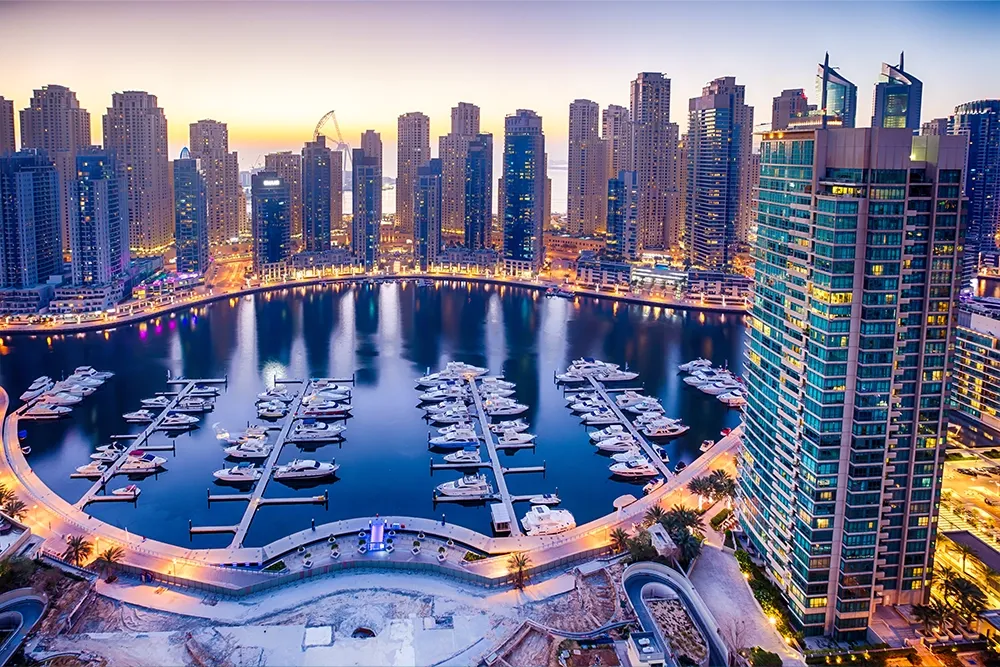
Dubai Marina is a practical starting point for many coastal briefs, but the exact embarkation point depends on the selected yacht and its berth. From the water, a route may take in views toward Palm Jumeirah, the Dubai coastline and other recognised landmarks before including time at anchor or a swim stop where conditions and local rules allow.
The World Islands may also feature in a proposed route, but access, anchoring and activity permissions must be checked for the specific plan. A place visible on a map is not automatically open for every vessel or activity.
Dubai Maritime Authority requires operators to follow designated anchoring areas, restricted-area rules and local speed limits.2 The captain may change the sequence, omit a stop or return to port if safety, visibility, traffic or official instructions require it.
Treat a sample itinerary as a planning tool rather than a guaranteed timetable. A sound proposal should identify the preferred route, the practical fallback and the decisions that remain with the captain or authorities.
For local destination context before requesting yachts, review the Dubai yacht charter page.
Can a Dubai charter extend to Abu Dhabi?
An Abu Dhabi extension can be considered for a multi-day brief, subject to the yacht, route and current permissions.
A government protocol announced in December 2025 and effective from January 2026 introduced mutual recognition of sailing permits issued by Dubai and Abu Dhabi for visiting foreign yachts. It also removed duplicate local entry and exit procedures for those yachts moving between the two emirates.3
This makes inter-emirate planning more streamlined for qualifying visiting foreign yachts, but it does not make every yacht or route automatically available. The broker and yacht representative should still confirm the vessel's permit status, passenger and crew information, berth arrangements, timing and captain-approved passage plan.
Ask whether the proposed yacht is already authorised for the relevant movement and what remains outstanding. The answer should separate a general regulatory possibility from a confirmed itinerary for your dates.
When might Musandam fit the itinerary?
Musandam offers a sharp visual contrast to Dubai's urban coast. Oman's official tourism site describes the governorate as a landscape of steep mountains and calm oceans opposite the Sea of Oman, Arabian Gulf and Strait of Hormuz. It identifies Khasab, Bukha, Dibba and Madha as the four main wilayats, with boat tours and diving among the area's activities.4
Its appeal does not remove the international-border requirements. A Dubai-to-Musandam plan must be checked against the selected yacht's flag, operating permissions, insurance, guest documentation, port arrangements, customs and immigration requirements. The route must also make sense within the available time and the captain's operational judgement.
Do not accept a fixed crossing time or a promise that every Dubai yacht can make the trip. Ask the broker to confirm the proposed yacht with its representative and identify the required agents and authorities. If the formalities or timing do not fit, a focused Dubai or UAE itinerary may provide a better charter.
How to plan a corporate yacht charter in Dubai
Start with the purpose rather than the yacht. Client hospitality, a private leadership meeting, employee recognition and a product presentation create different requirements.
Use this checklist before requesting options:
| Planning area | Questions to answer |
|---|---|
| Purpose | Is the focus conversation, dining, presentation, entertainment or a mix? |
| Guest count | How many guests, crew, hosts, performers and suppliers will be onboard? |
| Privacy | Are confidential conversations, controlled photography or private transfers required? |
| Layout | Is there appropriate seating, shade, circulation and separation between social and working spaces? |
| Catering | Is the format seated, buffet or canapés, and what dietary information is required? |
| Production | Are screens, microphones, music, lighting, décor or branded materials needed? |
| Timing | What are the embarkation, programme, cruising and disembarkation windows? |
| Access | Does any guest require easier boarding, lift access or mobility support? |
| Contingency | What is the alternative if conditions or an official instruction changes the route? |
Dubai Maritime Authority states that a marine craft cannot carry more people than its licence permits. It also requires authorisation before craft are used in maritime processions, advertising or other events.2 Confirm whether the proposed activity falls within the yacht's normal charter permission or needs an additional approval.
How to plan a birthday or private celebration
A birthday, anniversary or family celebration needs the same operational discipline as a corporate event, even when the mood is less formal.
Confirm the final guest list and distinguish daytime guests from anyone sleeping onboard. Describe the desired atmosphere, meal format, music, decorations, photography and water activities. Ask which suppliers may board, what equipment may be brought aboard and which materials are prohibited because they could damage the yacht or pollute the water.
For music or entertainment, check power, sound limits, equipment placement and permissions rather than assuming a land-venue setup can be copied onboard. For catering, confirm whether the yacht's chef will prepare the menu or whether an approved supplier is involved. For swimming and water toys, accept that the captain may alter the timing or cancel an activity because of conditions, traffic or a local restriction.
The best celebration plan is detailed but flexible. Protect the parts that matter most, then give the captain and crew room to adapt the sequence safely.
Which licences, passenger limits and documents should you check?
Dubai Maritime Authority licenses marine-craft rental activity to support safety and compliance. Its published obligations include licensed craft and crew, safe manning, maintenance records, voyage records, adherence to the licensed passenger limit, designated anchorages and restricted-area rules.2
For a visiting foreign yacht seeking permission to operate in Dubai, the published process includes an authorised marine agent, ownership and classification documents, a berthing contract or anchorage permit, insurance, captain and crew licences, a partnership with a locally licensed charter company, customs inspection and an entry permit supported by passenger and crew lists.5
Clients do not need to administer every document personally, but they should ask who has checked them. Useful questions include:
- Is the yacht authorised for commercial charter in Dubai for these dates?
- What is the licensed passenger limit for the proposed use?
- Are the captain and crew appropriately licensed?
- Does the route require a particular permit, agent or passenger submission?
- Does the event, branding or entertainment need separate authorisation?
- Which party is responsible for each approval?
A website listing or attractive brochure does not answer those questions. The broker should coordinate confirmation with the yacht's representative and explain any condition that affects the booking.
What should you send before requesting yacht options?
A precise brief produces a more relevant shortlist. Send the dates, preferred duration, total number of guests and number requiring overnight accommodation. State whether the booking is a private cruise, corporate event, celebration or multi-day itinerary.
Include the preferred embarkation area, route ideas and any interest in Abu Dhabi or Musandam. Add cabin requirements, mobility considerations, food preferences, water activities, entertainment, AV, privacy and transfer needs. Give a realistic budget range and ask for the estimate to show the base fee, operating costs, taxes, permits and event extras separately.
If your dates centre on the race weekend, see the separate Abu Dhabi Grand Prix 2026 yacht charter planning guide for Yas Marina berth, ticket and yacht checks. It is not a substitute for a live availability enquiry.
If you are comparing advisers as well as yachts, use the seven questions in How to Choose a Yacht Charter Broker. For a broader explanation of the role, read What Is a Yacht Charter Broker?.
Final Dubai charter booking checklist
Before signing, confirm the yacht, dates, duration, passenger limit, embarkation point and contracting parties. Review the payment schedule, cancellation terms and the treatment of variable expenses. Make sure the intended route and activities have been checked with the yacht's representative and that no sample stop is presented as guaranteed.
For an event, record the agreed guest number, suppliers, catering, music, branding, photography and timing. For a multi-day charter, confirm overnight capacity, provisioning, berth or anchorage plans, any delivery costs and the process for Abu Dhabi or Musandam if either is included.
Finally, understand who will communicate with you before the charter, who handles an operational change and how final expenses will be reconciled. Clear responsibilities matter as much as the yacht itself.
When your dates and brief are ready, search crewed charter yachts or send a detailed charter enquiry. The shortlist should follow the brief, not the other way around.
References
Planning a charter?
Tell us your dates and destination. Our charter team will review your brief and prepare a suitable shortlist.